 No PhD required to understand. Just curiosity
Scientists used sound to float two tiny foam beads and studied their movements. Experiment with the beads yourself and watch what they found. The visuals are slowed down about 60 times and drawn bigger than in real life.
Read the article on EPhyNews ↗Small speakers play sound at 40,000 vibrations per second. The sound waves overlap and make a pattern that stays in place: loud spots and quiet spots.
Try this: Drag the bead onto a loud spot and let go. Slide the frequency and see the change.
The result of the pressure: the squeezed air at a loud spot pushes harder than the calm air at a quiet spot, so the bead settles into a quiet spot. There, the bead is pushed up and down equally, 40,000 times a second. Since the bead is too heavy to follow the air and the pushes are equal, the bead stays still.
Air resistance slowly takes away a moving bead’s energy. So if nothing is pushing, it eventually stops. But in this case, there is something that pushes the beads: the sound that bounces off one bead pushes the other.
Try this: Pick each option and press “Tap”. Which ones keep dancing?
Different-sized beads can dance in two ways. A smaller pair moved together, and a bigger pair moved opposite. The opposite dance is the time crystal: its beat belongs to the pair, not to a single bead.
Try this: Press “Start from still” and watch both pairs. The dance grows by itself.
The animations above are simplified models. These links show the real device and the research paper itself. The beads bounce about 66 times a second in the real experiment, too fast to see with your eyes.
 Time crystals you can hold in your handNew York University’s own video about the research.Watch on YouTube ↗
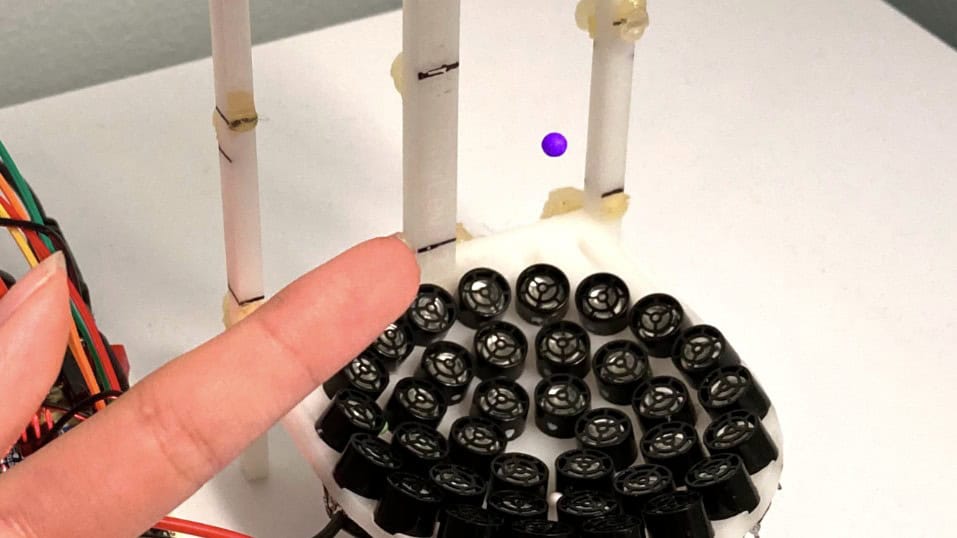 Time crystal emerges in acoustic tweezersThe device, the floating bead and what other physicists think.Read on Physics World ↗
arXiv
 The paper, free to readThe full research paper for free.Read on arXiv ↗
PRL
 The paper itself (Physical Review Letters)The official published version of the research.Read in Physical Review Letters ↗
Source. Morrell, M. C., Elliott, L. & Grier, D. G. Nonreciprocal wave-mediated interactions power a classical time crystal. Phys. Rev. Lett. 136, 057201 (2026). https://doi.org/10.1103/zjzk-t81n. The simulations on this page are simplified illustrations designed by Ermuun Battulga, not the authors' data.
Thank you!
Every new one comes with its own article. Subscribe for free and get notified as soon as they're ready.