 No PhD required to understand. Just curiosity
Water droplets on a very hot pan move around instead of boiling. Scientists in Hong Kong and their partners made a solid block do the same, but at a much lower temperature. Try it yourself below and find out why. The steam film is drawn much bigger than in real life.
Read the article on EPhyNews ↗When a water drop lands on a hot pan, its bottom starts turning into steam. If the pan is hot enough, the steam forms so fast that it makes a thin layer that lifts the drop. The steam is trapped under the drop. It escapes slowly at the edges, while new steam keeps forming.
Try this: Slide the temperature up and watch the drop levitate on its own.
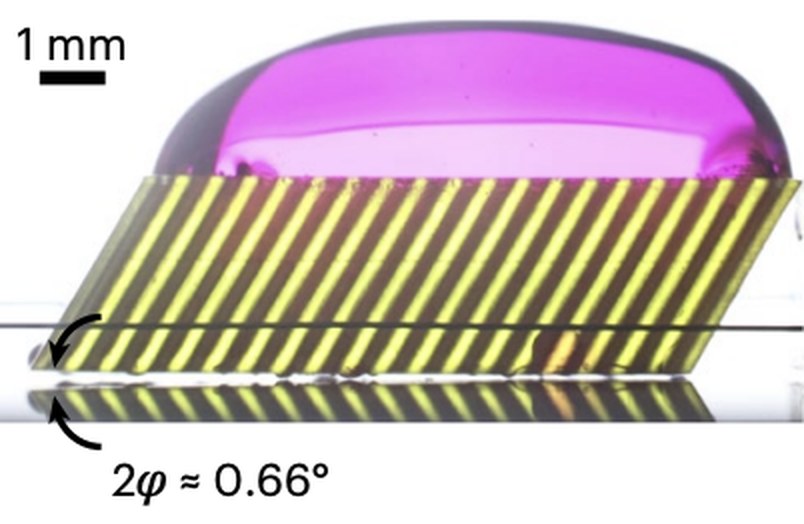
The researchers 3D-printed a small block (10 × 5 × 3 mm) full of thin channels about 0.3 mm wide, and filled them with water. Unlike a water droplet, which needed a surface of about 200 °C to float, the block lifted off at only 110 °C.
Try this: Change the thickness and number of channels, then find the lowest temperature where the block still floats.
The channels are very thin (about 0.3 mm), so surface tension keeps the water inside. The steam has to squeeze out through the tiny gap under the block, and that squeeze pushes the block up. It floats once this push is as strong as its weight.
A water drop and the block are on the same plate. The drop touches the plate and boils away. The block floats, because its channels store water like a small tank. They keep making steam until the water runs out.
Try this: Change the temperature and watch the race.
In the paper, at 130 °C, the drop was gone in 1.5 s. The block floated for about 2 minutes. Adding a little water every 30 seconds to the block kept it up for 10 minutes.
When the channels are tilted, the steam leaves more to one side, so it pushes the block a little sideways. With almost nothing rubbing underneath, that small push is enough to make the block glide by itself.
Try this: Find the tilt that makes the block fastest.
Past about 20°, the paper found that one side of the block gets heavier. That side can’t make enough steam to hold itself up, so the block no longer floats evenly and slows down.
The animations above are simplified models. These links show the real paper and what the team says about it. The paper also floated natural materials full of channels: balsa wood and cuttlefish bone.
Try this: Watch the team's 5 videos. They show the real version of each step above.
 The Leidenfrost effect at homeThe Sci Guys show water drops skating on a hot pan.Watch on YouTube ↗
Free PDF
 The paper, free to readThe full research paper for free, from the University of California.Read on eScholarship ↗
CityUHK
 The team's own storyCity University of Hong Kong explains the discovery.Read on CityUHK ↗
5 videos
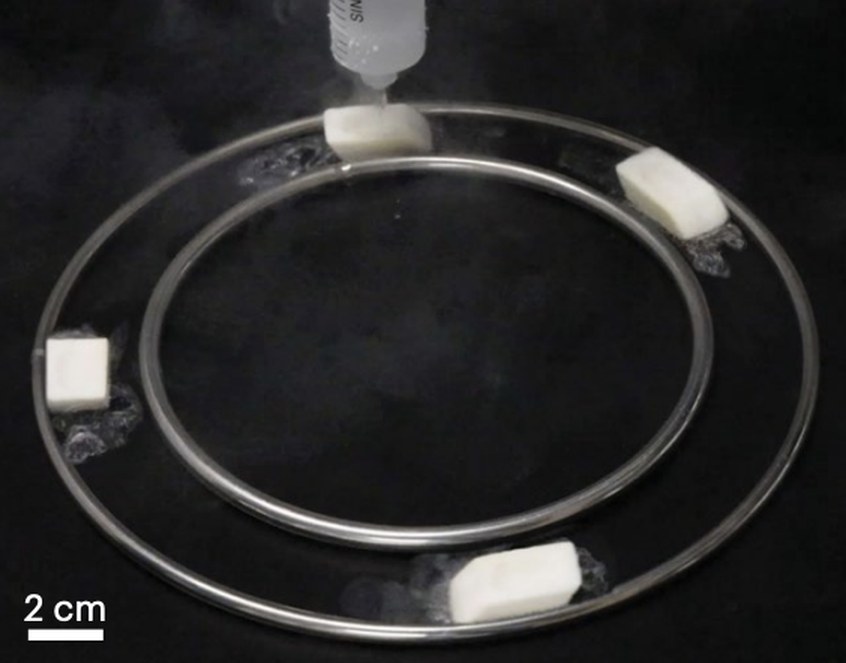 The team's 5 videosThe real blocks floating, racing a drop and carrying loads.Watch on Nature Physics ↗
Source. Zhang, Z. et al. Capillary Leidenfrost effect. Nat. Phys. 22, 791–798 (2026). https://doi.org/10.1038/s41567-026-03255-x. The simulations on this page are simplified illustrations designed by Ermuun Battulga, not the authors' data.
Thank you!
Every new one comes with its own article. Subscribe for free and get notified as soon as they're ready.