 No PhD required to understand. Just curiosity
Can a gas hold itself together and not spread out?
In 2026, scientists turned an ultracold gas of molecules into a liquid drop. Start here to see the strange part.
Read the article on EPhyNews ↗There are two kinds of particles: bosons (like photons) and fermions (like electrons, protons & neutrons). In quantum mechanics, each particle is described by a wave function (ψ), which tells where it might be.
- When bosons get close, their wave functions add up (symmetric).
- When fermions get close, their wave functions cancel (antisymmetric).
Try this: Slide and see the combined wave functions.
When 2 bosons meet, their combined wave gets taller → higher probability.
When 2 fermions meet, their combined wave becomes 0 everywhere → 0 probability.
A particle that exists can't have 0 probability, so fermions can't be together.
What happens when temperature drops?
When particles cool down, their energy decreases. They drop to lower energy levels.
Try this: Slide the temperature down and see how the particles spread.
condensate
One wave function represents many bosons
When the temperature decreases, the kinetic energy of the particles decreases. That means the particles slow down.
So when particles slow down, their wavelength increases. The waves spread out more, so the probability of finding each particle spreads out too.
Try this: Slide the temperature down and see the change.
Top: atoms seen from above (the glow is the probability cloud of finding an atom). Bottom: |ψ|² graph of the atoms. Left: energy levels.
Why did molecules take 30 years?
Atoms formed a Bose-Einstein condensate (BEC) in 1995. Molecules only did it in 2024.
Try this: Slide the temperature down and compare both situations.
Blue ring: the microwave shield. Pink flash: two molecules sticking together and flying out. Dashed oval: the trap.
The 2024 solution: microwaves. When two molecules get close, the microwaves make them push each other away, like a shield. So the molecules don't become fast, stay in the trap and keep cooling.
Can a gas stop spreading out?
In 2026, the same lab unbalanced the shield's microwaves on purpose. The round shield gets squished, so molecules act like tiny magnets all pointing one way: end to end they pull, side by side they push each other.
A gas with the normal shield spreads out without the trap. But the unbalanced shield makes the molecules pull each other into a drop that stays together.
Try this: Unbalance the microwaves, then switch the trap on and off.
Blue ring: the microwave shield, squished when unbalanced. Green glow: the drop. Dashed oval: the trap.
The real research
The simulations above are simplified models. These links show the real papers and news about them. The surprising part: the real cloud sometimes split into a row of 2 to 4 drops, lined up end to end like the tiny magnets in Step 05.
Try this: Open the free droplet paper and see the pictures taken after the trap was switched off.
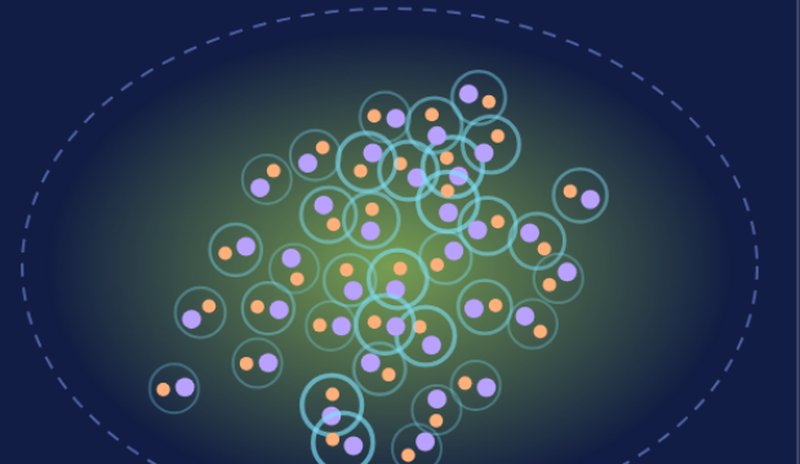 The first molecule BECThe 2024 paper: molecules cooled to about 5 billionths of a degree.Read the paper ↗
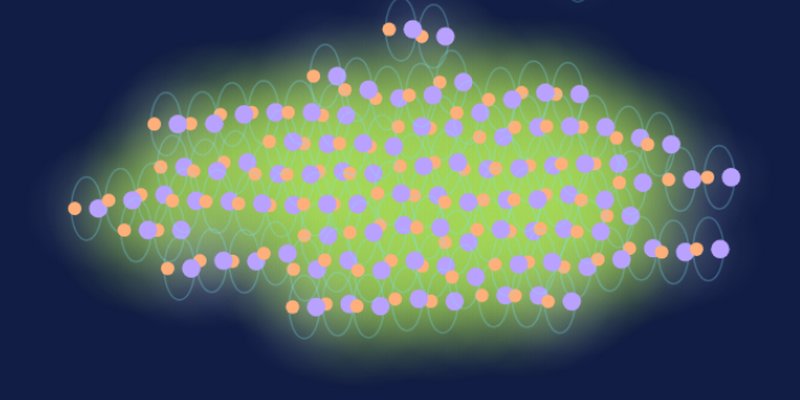 The droplet paper (free)The 2026 paper, free to read, with the trap-off pictures.Read the paper ↗
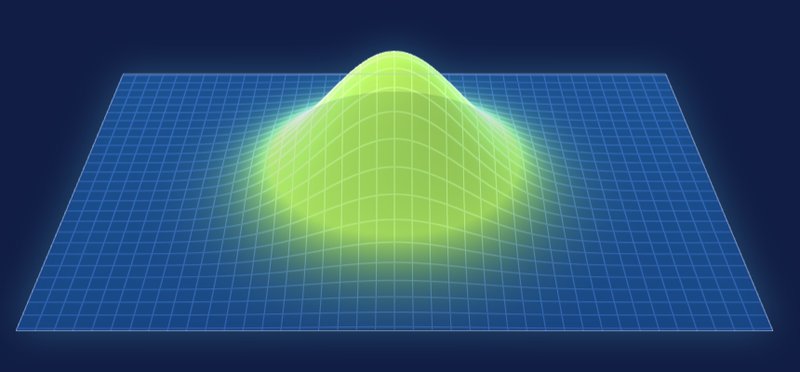 Columbia newsThe lab explains the drops and what comes next.Read the news ↗
 Radboud newsThey call it the first liquid made of ultracold molecules.Read the news ↗
Source. Bigagli, N. et al. Observation of Bose–Einstein condensation of dipolar molecules. Nature 631, 289–293 (2024). https://doi.org/10.1038/s41586-024-07492-z. Zhang, S. et al. Observation of self-bound droplets of ultracold dipolar molecules. Nature 651, 601–606 (2026). https://doi.org/10.1038/s41586-026-10245-9. The simulations on this page are simplified illustrations designed by Ermuun Battulga, not the authors' data.
Thank you!
Want the next simulation?
Every new one comes with its own article. Subscribe for free and get notified as soon as they're ready.